The clock struck 2026, and the wizarding world held its breath. Rumors of a sequel to Hogwarts Legacy had been swirling for three years, and now the first cryptic teaser had dropped. In the dim glow of a monitor, a veteran player of the original game leaned back, memories flooding back of soaring through the Highlands and brewing polyjuice potion in dimly lit chambers. But as the teaser flickered through fleeting glimpses of the Great Hall and the clinking of goblets, one thought crystallized: would this new adventure finally let them feel like a true member of a single house, surrounded by loyal, inseparable friends? Or would it again scatter companions across all four houses, sacrificing depth for a wider, thinner thread of acquaintance?
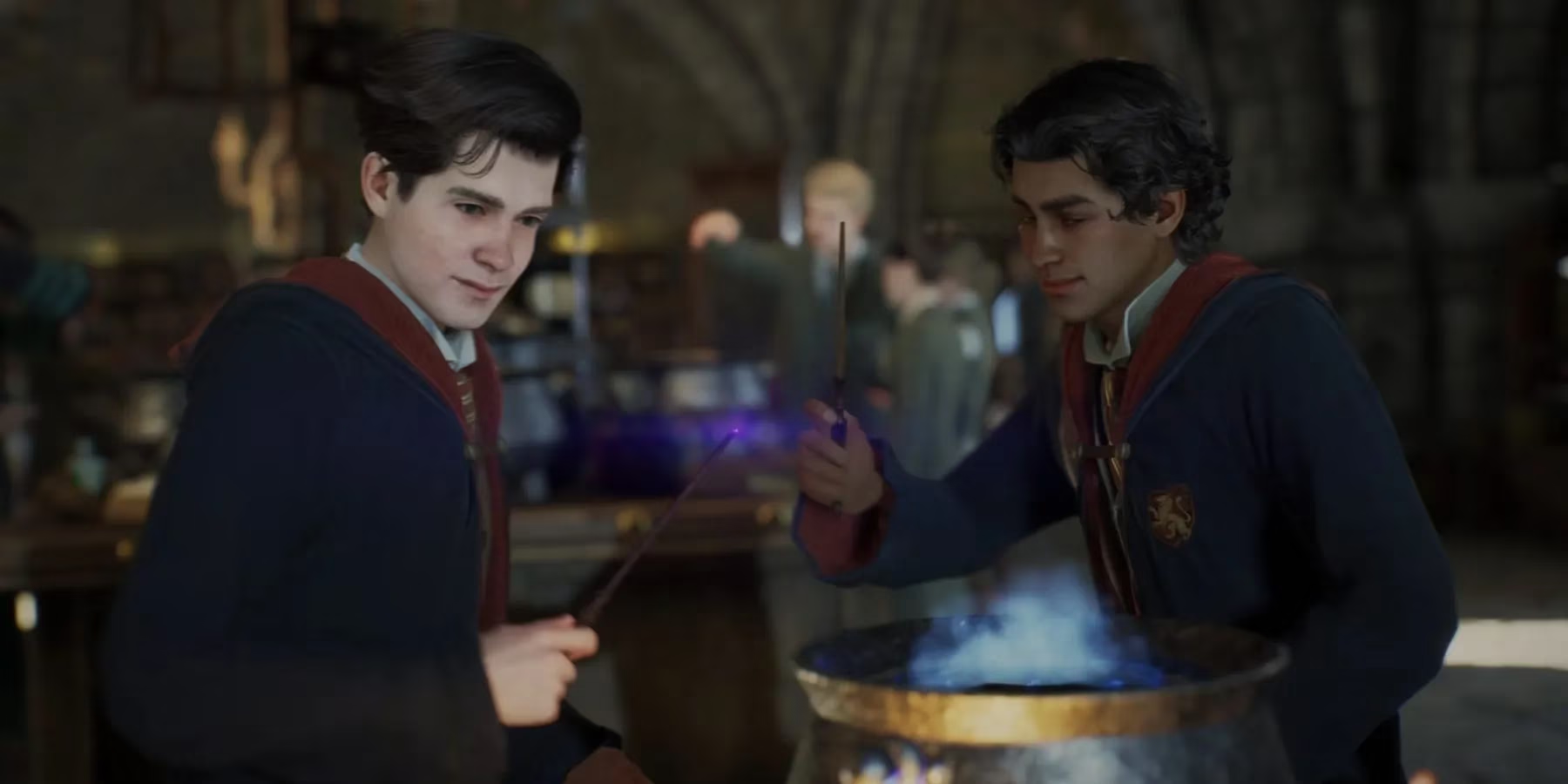
When the first Hogwarts Legacy launched, it did something genuinely bold. For generations, Harry Potter fans had been conditioned to believe that meaningful camaraderie was almost exclusively confined within one’s own house. The story of the Boy Who Lived was a Gryffindor saga; Ron and Hermione, both lions, were the constant heartbeat. Harry’s interactions with Ernie Macmillan or Hannah Abbott from Hufflepuff were polite, his alliance with Luna Lovegood quirky but limited, and his connection to Slytherin’s Draco Malfoy defined by rivalry, not fellowship. Even his later entanglement with Ravenclaw’s Cho Chang was built on fleeting infatuation, not steady companionship. Hogwarts Legacy shattered that mold by giving players a ‘companion’ relationship with characters from each house: the courageous Gryffindor, the clever Ravenclaw, the loyal Hufflepuff, and the resourceful Slytherin. It was, in theory, a democratic design that celebrated the entire student body.
Yet in practice, this breadth came at a cost. The player’s bonds felt like curated acquaintanceships rather than the forged-iron friendship shared by the iconic trio. One never sat with a single companion by the fireplace in the common room for hours, whispering secrets or plotting mischief. Instead, each house offered a narrative slice, but none felt like a home-cooked meal. The system lacked staying power. Developers at Avalanche Software now faced a monumental choice for the sequel: lean into the nostalgia of an insular house-based companion crew, or expand the open-house philosophy with richer, interweaving story arcs. The former was a siren song of nostalgia. After all, being sorted into a house carried emotional weight precisely because it promised a micro-family, a tribe where one would find their Ron and Hermione. In a sequel, arriving as a new fifth-year or even a first-year, players could meet their future best friends on the Hogwarts Express, and that instant bond could dictate the entire emotional arc of the game. Sharing a dormitory, sneaking into the common room after curfew, and defending each other in house-point competitions would forge an identity far stronger than any external questline.
However, choosing the house-locked route would demand something the original game occasionally struggled with: consistent, stellar writing across all options. If a player unlucky enough to be sorted into a house received a companion like Ravenclaw’s Amit Thakkar—whose questline in the first game was widely criticized as shallow and forgettable—the entire experience would sour. Imagine being chained to a lackluster ally for 60 hours while friends in other houses raved about their charismatic partners-in-crime. No developer could afford such imbalance. Thus, Avalanche would need to ensure that whoever the companion was in Gryffindor, Slytherin, Hufflepuff, or Ravenclaw, their personality, quests, and growth rivaled the best character arcs in modern action-RPGs. This would mean fully voiced dialogues, personal stakes, and perhaps even loyalty missions that alter the companion’s fate.
Some insiders in 2026 speculated about a hybrid model: what if the sequel introduced a primary, house-bound companion who was always at your side, while still allowing meaningful optional friendships with students from other houses? This would mirror Mass Effect or Persona series, where a core team member shares your origin, but the wider social web remains accessible. Others whispered of a more daring step—romantic companionships. The original game kept all relationships strictly platonic and adolescent in tone. A sequel, with its older protagonist or a more mature narrative, could allow friendships to bloom into something deeper, adding stakes that the first game only hinted at.
Walking through the corridors of the mind, one could see the allure of both paths. A single-house companion system would deliver a tight, emotionally resonant story, rekindling the comforting Harry Potter nostalgia of an inseparable trio. An open-house system, if executed with depth, would celebrate the unity between houses that the wizarding world always needed but rarely achieved. The sequel’s first trailer had shown a glowing Hogwarts crest, but it had split into four separate streams of light before merging again. Was it a hint?
The veteran player leaned closer to the screen and smiled. Could Hogwarts Legacy 2 finally ask the question: what if your house didn’t define the limits of your love, but your choices did? The answer would echo through the stone walls soon enough.
Comments