When I first stepped into the hallowed halls of Hogwarts as a fifth-year student in Hogwarts Legacy, I, like many others, faced a choice that felt far heavier than simply picking a dormitory. The Sorting Hat had barely brushed my head before I heard that silky voice whisper temptations of greatness, of ambition, of a legacy written in silver and green. I know you’ve probably wondered the same thing while gripping your controller: Why would anyone willingly join the house that produced Lord Voldemort and Draco Malfoy? After spending over a hundred hours in this breathtaking open-world recreation, I can tell you the answer is far more nuanced than the old books ever let on.
It’s no secret that this game has become a phenomenon. By 2026, Hogwarts Legacy has cemented its status as one of the best-selling games of the decade, surpassing even the wildest day-one predictions. Back in 2023, it moved a staggering 22 million copies, outselling heavy hitters like The Legend of Zelda: Tears of the Kingdom. And yet, for all its incredible open-world design and spell-slinging combat, the true magic might just lie in how developer Avalanche Studio dared to rehabilitate the most maligned house in all of wizard-kind: Slytherin.
In the original Harry Potter series, Slytherin was the silo for all things despicable. Every bully, every bigot, every Death Eater in training seemed to slither out of those dungeons. The house traits—cunning, ambition, resourcefulness—were twisted into synonyms for selfishness and cruelty. Even as a kid, I felt this was a missed opportunity. J.K. Rowling’s decision to paint an entire quarter of the school with the same villainous brush always left a sour taste. But Hogwarts Legacy hands us the palette and says, “See for yourself.”
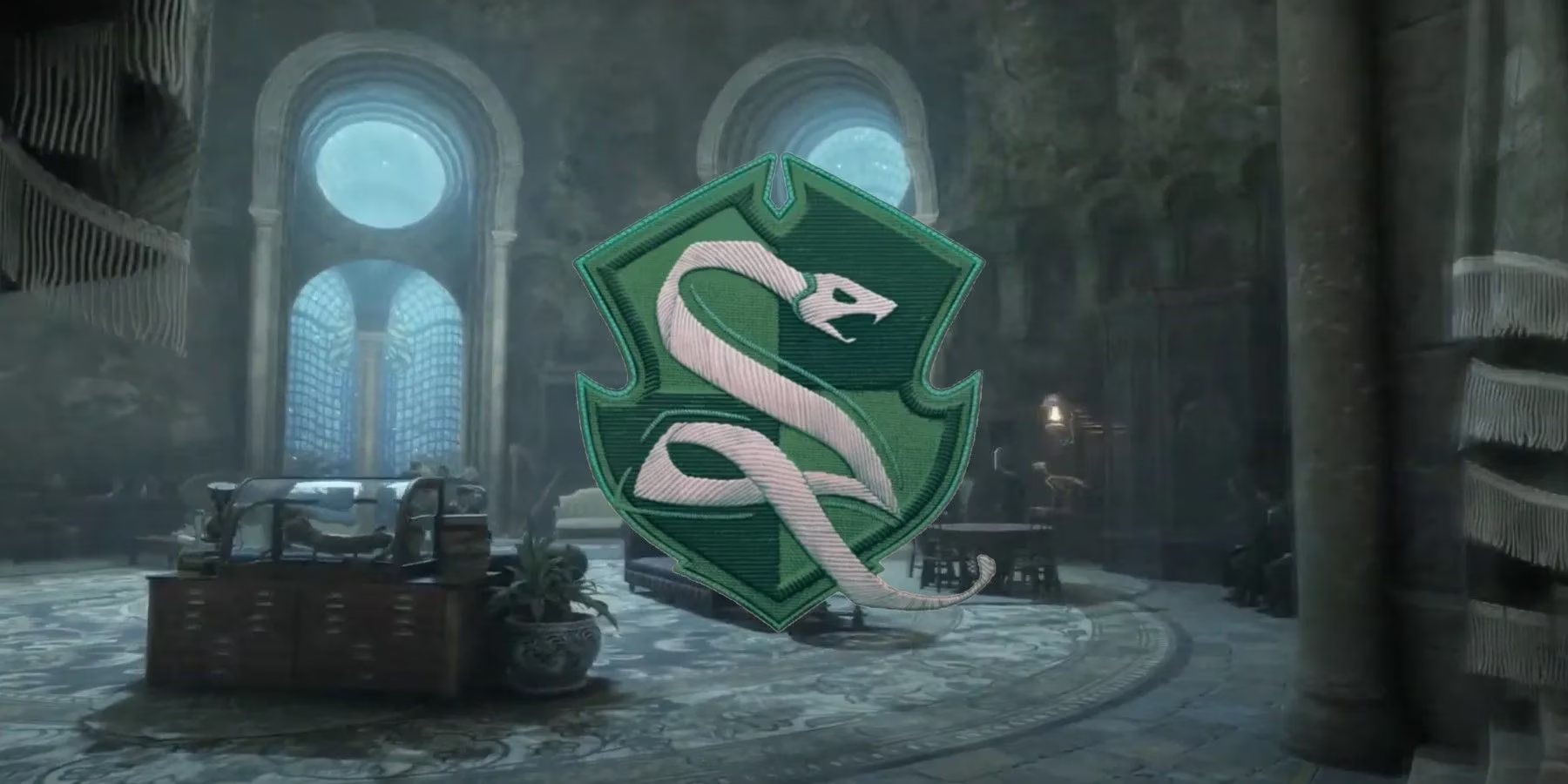
What does “see for yourself” actually look like? It starts the moment you descend into the Slytherin common room. Gone are the cramped, static descriptions from Pottermore; here, the common room is a majestic, glass-walled chamber submerged beneath the Black Lake. Giant squid drift past the arched windows, casting ethereal shadows over emerald furnishings and gothic stonework. I’d spend minutes just watching the aquatic life, feeling like I’d discovered a secret sanctuary rather than a villain’s lair. This setting alone invites you to question every assumption. How could a place so hauntingly beautiful breed nothing but darkness?

The answer walks in the form of two unforgettable companions: Ominis Gaunt and Sebastian Sallow. Ominis, a descendant of Salazar Slytherin himself, should be the poster child for inbred dark wizard mania. His family name is practically synonymous with Cruciatus Curse torture sessions on helpless Muggles. Yet, the Ominis I met in that common room was blind, kind, and utterly terrified of his own legacy. He’s the first to chuckle at a harmless prank—convincing first-years a mermaid just swam by is a personal favorite—but he draws a steel-hard line at real harm. Isn’t it a revelation to see a Gaunt who recoils from the Unforgivable Curses? It made me realize that even in the wizarding world’s most tainted bloodline, there is a choice.
Then there’s Sebastian, the charming, reckless fifth-year whose desperation drives the game’s most gripping subplot. His twin sister Anne has been struck by a mysterious, debilitating curse. Sebastian doesn’t dive into the Dark Arts because he craves power or immortality. He does it out of a raw, aching love. He believes, with every fiber of his ambitious being, that he can find a cure where all others have failed. Who among us wouldn’t bend a few rules to save someone we love? The game forces you to stand beside him as he walks a razor’s edge, and in doing so, it redefines what Slytherin ambition can mean. Ambition isn’t always about self-glory; sometimes it’s the ferocious drive to drag your sister back from the brink.
And let’s not forget Imelda Reyes, the ultra-competitive Quidditch aspirant. Her ambition doesn’t threaten world domination; it manifests on the pitch and over tense games of Wizard’s Chess. She’s sharp, confident, and unapologetically determined—not a single Unforgivable in sight. Through these characters, Hogwarts Legacy proves that cunning can be a tool for protecting friends, and ambition can fuel the pursuit of excellence in sports or scholarship. The traits are neutral; it’s the heart that decides the outcome.
So, why did a staggering number of players, myself included, flock to the serpent’s banner? Because for the first time, we could. The mystery that the books withheld for seven volumes was finally an open book. We could judge for ourselves whether the green and silver truly represented evil or simply a misunderstood intensity. The game doesn’t whitewash the house’s history—the whispers of dark magic still coil in the corners—but it gives you companions who stand in the light.
As I sit here in 2026, long after the credits rolled, I still believe Hogwarts Legacy is the start of something larger. Future additions to wizarding world canon would be wise to continue this path of rehabilitation. The idea that a quarter of all magical children are doomed to become villains is a narrative dead end. Slytherin can be the house of survivors, of strategists, of fiercely loyal friends who simply don’t wear their hearts on their robes. What started as a gaming trend has blossomed into a necessary cultural correction. I didn’t just play as a Slytherin; I understood what the Sorting Hat might have seen all along—a beautiful, complex, and deeply ambitious heart.
Comprehensive coverage can be found on PlayStation Trophies, where community-driven guides often map out house-specific questlines and collectible routes, helping explain why many players gravitate toward Slytherin in Hogwarts Legacy: the house’s companion quests and exploration flow naturally reward curiosity, strategic problem-solving, and a completionist mindset that fits the “cunning and resourceful” fantasy without leaning on old villain stereotypes.
Comments