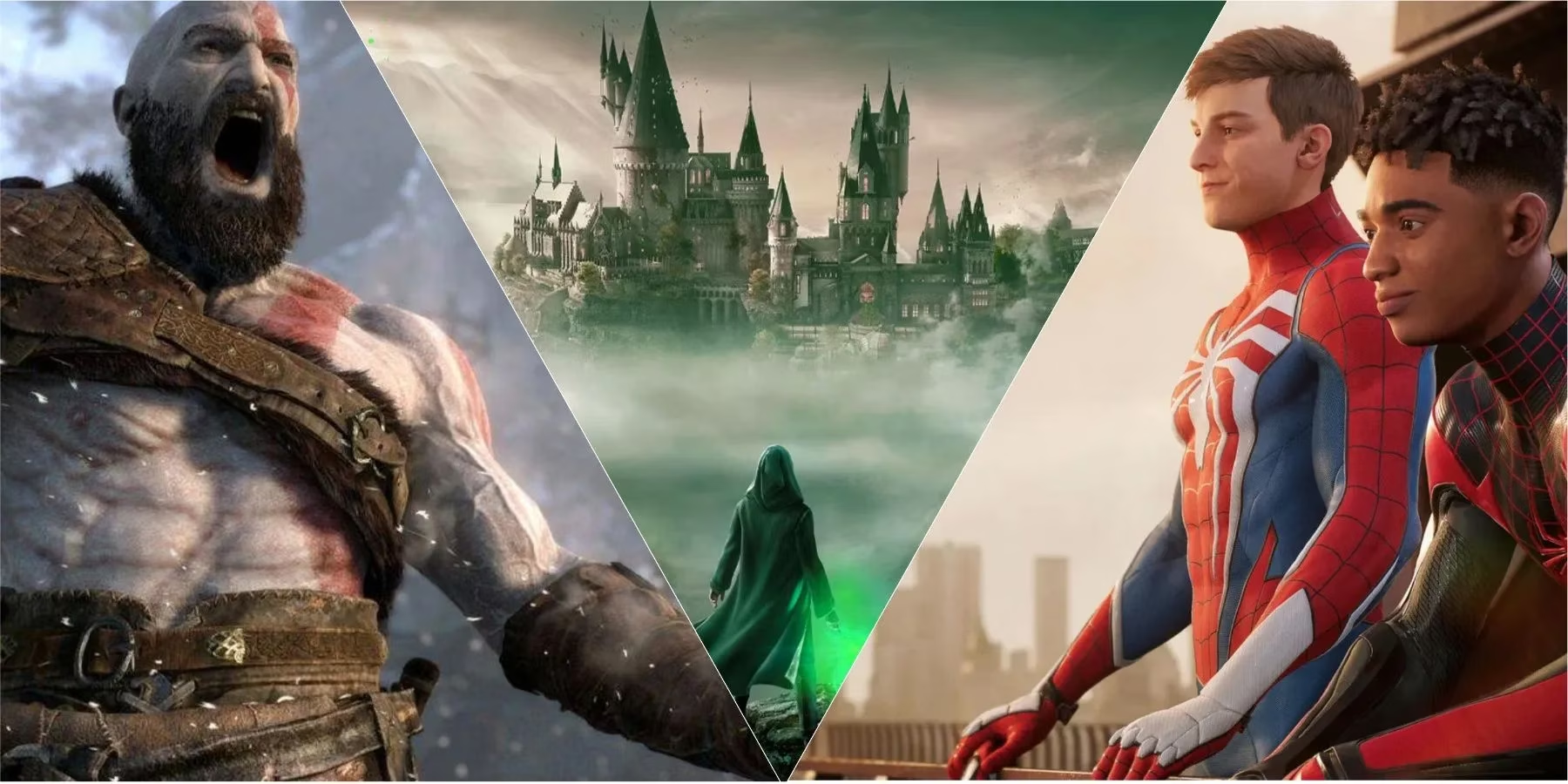
I have spent the last few years watching a quiet but unmistakable shift in how major publishers approach blockbuster franchises. Video games have traditionally been easy to sort into neat boxes: brand-new IP, established sequels, remakes, or spin-offs. But recently, a fifth category has started taking root across the AAA space—the half-sequel. Not quite a full sequel, not just a large expansion, these projects follow a known universe, feature a tighter scope, and often carry a slightly lower price tag. And while rumors keep swirling around new half-sequels for Marvel’s Spider-Man 2 and God of War, I believe the franchise with the greatest untapped potential for this model is actually Hogwarts Legacy.
The Half-Sequel Playbook
The appeal of a half-sequel is not difficult to understand. Developers can deliver a polished experience with roughly half the length and scope of a full sequel while charging only about $10 less than a standard $60 or $70 release. Marvel’s Spider-Man: Miles Morales remains the clearest blueprint. Insomniac launched it at $50, gave players a shorter but densely packed adventure, and turned a bridge project into a massive commercial win. That kind of efficiency is increasingly attractive when full sequel development cycles stretch to five or even six years.
Right now, industry chatter suggests both Insomniac and Santa Monica Studio are leaning into the format again. A Venom-led follow-up to Marvel’s Spider-Man 2 would let Insomniac pick up dangling symbiote plot threads without committing to a full numbered sequel immediately. Likewise, a God of War half-sequel following Atreus on his search for the missing Giants would answer lingering narrative questions while giving Kratos a well-earned rest. Both ideas make logical sense. But here is the question I keep asking myself: don’t those franchises already have built-in momentum? Wouldn’t a half-sequel serve an equally beloved but structurally freer world even better?
Why Hogwarts Legacy Stands Out
That brings me back to 2026 and the peculiar position of Hogwarts Legacy. Since its explosive 2023 debut, the game has become one of the defining open-world successes of the decade. Yet despite all the demand for more Wizarding World content, a direct successor remains frustratingly elusive. A full sequel will eventually arrive, but in the meantime, a half-sequel could do something no Spider-Man or God of War follow-up can easily replicate: reinvent itself completely while staying inside the same universe.
The core strength of Hogwarts Legacy is structural flexibility. The first game established that the player character can be virtually anyone—a late-blooming fifth-year student with an unusual connection to ancient magic. That premise invites endless variation. A half-sequel could return to the same protagonist a few months later, exploring how the school reacts to the events of the first story. Or it could hand players control of a companion such as Sebastian, Poppy, or Natsai, giving those relationships much more room to breathe. Alternatively, a half-sequel might introduce an entirely new student decades earlier or later, or even put players in the robes of a young professor.
Would that diluted identity hurt the brand? I would argue the opposite. The Wizarding World is vast enough to support interconnected stories without repeatedly leaning on the same cast. Harry Potter itself proved that audiences will follow different protagonists across different eras when the setting remains enchanting. A half-sequel could lean into the school calendar, focusing on a single term rather than an entire academic year, which naturally shortens the scope without making the adventure feel incomplete.
A World Built for Reinvention
The setting of Hogwarts Legacy also makes this transition easier than it would be for many other AAA franchises. The castle itself—an iconic, carefully realized space—could remain mostly intact, preserving fan familiarity and saving significant production resources. Meanwhile, the surrounding hamlets, Forbidden Forest, Black Lake, and even unseen corners of the wizarding world could evolve dramatically. A half-sequel set during a different season, festival, or Triwizard-style event could give the same map a fresh personality. Better yet, the team could leave Scotland behind entirely and explore Uagadou, Castelobruxo, Mahoutokoro, or an entirely new magical institution.
Here is a quick comparison of how the three rumored half-sequels might approach their hooks:
| Franchise | Natural Half-Sequel Hook | Likely Protagonist |
|---|---|---|
| Marvel’s Spider-Man 2 | Aftermath of the Venom symbiote | Venom or another wall-crawler |
| God of War | Searching for the missing Giants | Atreus |
| Hogwarts Legacy | New term, new student, or companion story | Flexible original witch or wizard |
That table reveals exactly why Hogwarts Legacy stands apart. Spider-Man and God of War half-sequels are largely extensions of established protagonists or immediate successors. Hogwarts Legacy can instead treat each half-sequel like a new chapter in a broader anthology. The toolset already exists: deep combat, creature care, potion-making, exploration, and a reactive social ecosystem. A shorter project would not need to rebuild those systems from scratch—it would simply redirect them toward a new story.
The Case for Moving Faster
There is also a practical business argument. The gap between major Wizarding World releases remains enormous, and the audience has already shown it will embrace smaller-scale stories if they feel authentic. Rather than forcing players to wait through another lengthy development cycle, Warner Bros. and Avalanche could greenlight a half-sequel that arrives sooner, recharges interest in the property, and tests experimental ideas for the eventual full sequel. What if the next big mechanic is introduced in a tighter package first? Would that not reduce risk for the numbered follow-up?
I am not suggesting Hogwarts Legacy should abandon a full sequel. That sequel is clearly on the horizon and will command enormous attention whenever it is revealed. But before the franchise disappears into another multi-year silence, a half-sequel could keep the conversation alive, deepen the parts of the first game that worked, and satisfy a fanbase hungry for more magic. If Miles Morales taught the industry anything, it is that smaller can still feel spectacular.
At this point, the real question is not whether the half-sequel trend will continue—it clearly will. The question is which publisher recognizes that the model works best when the source material is flexible enough to support dramatic change. To me, no modern franchise fits that description better than Hogwarts Legacy. The castle is waiting.
Comments