In the smoky backroom of Avalanche Software, where enchanted whiteboards supposedly scrawl their own sequel ideas, a peculiar silhouette is forming. While the world waits for an official announcement that has the patience of a sleeping dragon, the gaming community has been busier than a niffler in a Gringotts vault, tossing around theories about the inevitable Hogwarts Legacy 2. The first game outsold even the sacred trifecta of Zelda, Diablo, and Call of Duty in 2023, making it one of Warner Bros.’ most enchanted cash registers. Yet, like a wizard trying to cast Avada Kedavra without a wand, a direct sequel remains unmanifest. When it does, the creative team must juggle flaming phoenixes—where to take the story, how to evolve Hogwarts itself, and how to avoid the dreaded curse of repetitive open-world tedium.
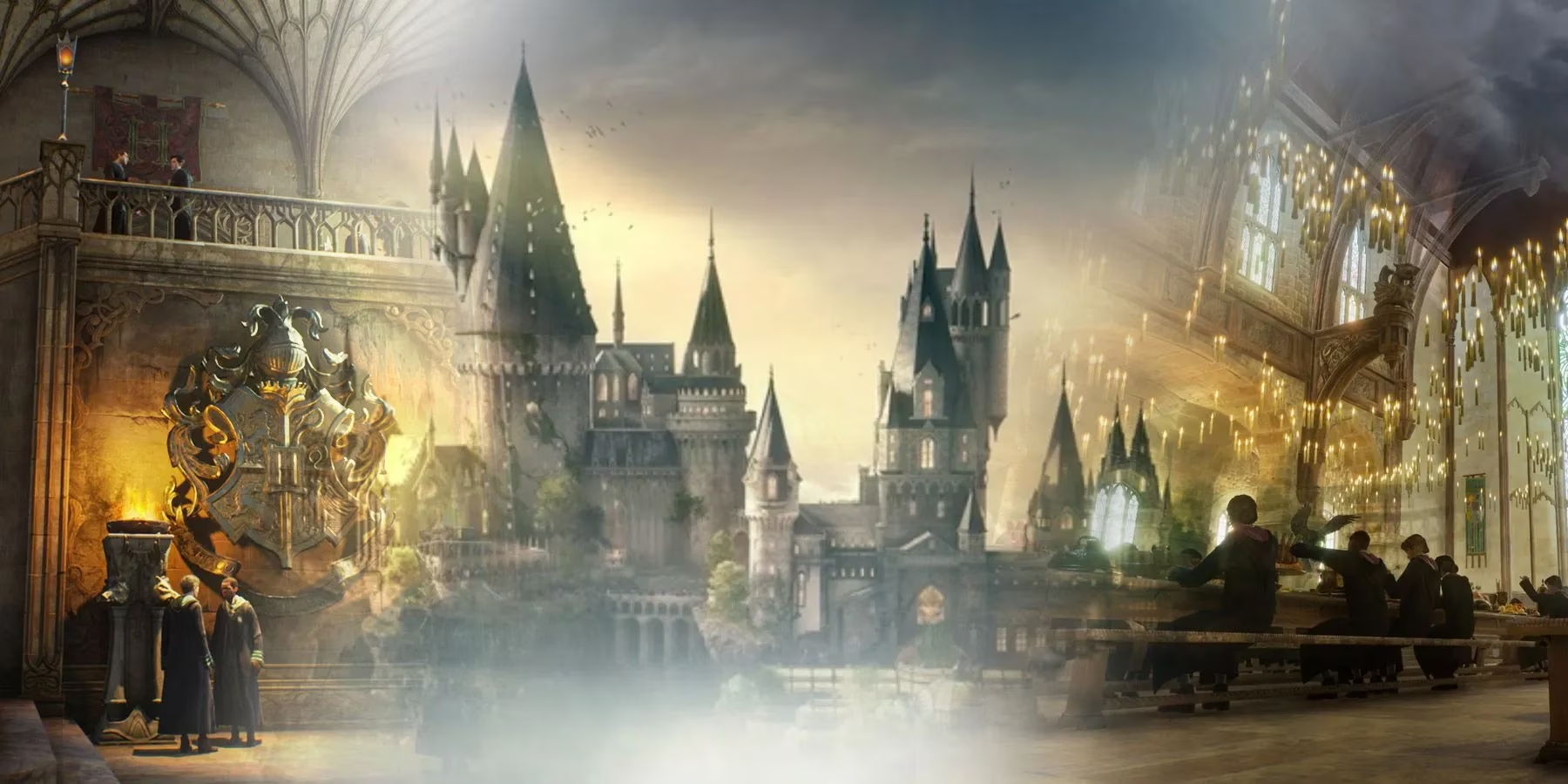
Among the bubbling cauldrons of speculation, one potion stands out with a particularly brilliant shimmer: an exchange student protagonist. Not a continuation of the ancient-magic-wielding fifth-year who could dismantle trolls before breakfast, but a fresh face from a foreign wizarding school, arriving at Hogwarts with a suitcase full of cultural confusion and a mind like a blank page of Tom Riddle’s diary. This isn’t just a gimmick—it’s a master key that could unlock three jammed doors simultaneously.
First, it hands the sequel an identity as distinct as a Dementor’s breath in a summer meadow. Let players step into the robes of a Beauxbatons or Castelobruxo student who suddenly finds themselves navigating the soggy Scottish Highlands. The immediate effect is like putting on a pair of Omnioculars from an unfamiliar Quidditch final: everything old becomes new again. Hogwarts’ moving staircases, the portraits that gossip like soap-opera stars, the very smell of pumpkin pasties—all hit with a disorienting freshness when seen through an outsider’s eyes. It’s an approach that sidesteps the risk of making the sequel feel like a tired rerun of the first game’s routine. Instead of revisiting the same common-room fireplaces, the exchange student’s journey could feel like reading Hogwarts: A History after only knowing the abridged version.
Dig deeper, and this narrative potion cures a headache that quietly throbbed in the original. In Hogwarts Legacy, the Sorting Ceremony was supposed to be a defining moment, yet it quickly became a theatrical Venn diagram with glaring empty circles for certain houses. Ravenclaw players, especially, were left clutching scraps of exclusive content like someone who ordered a seven-course feast and received only the breadsticks. An exchange student would not need to be sorted at all. They could wear the robes of their original school while dipping into Hogwarts as an observant visitor, interacting with all four houses equally. The sequel could weave a story where house loyalty becomes a matter of choice or a fluid alliance rather than a locked gate. No more feeling like the sidekick in a Gryffindor-focused epic; instead, the protagonist becomes a magical anthropologist, sampling each dormitory’s subculture without being trapped in one.
Moreover, this setup grants the developers a creative license as broad as the Forbidden Forest. The player-character can arrive from a school built into the heart of a Norwegian mountain, or a Brazilian rainforest academy where Care of Magical Creatures involves actual caipora spirits. They can be a prodigy, a remedial wand-waver, a seventh-year about to take their N.E.W.T.s, or a teenager who’s never seen a Bowtruckle. There’s no backstory weight, no pre-established relationship with the castle’s secrets. It’s a narrative buffer zone—a Silencing Charm placed over any potential contradictions with the looming HBO adaptation of the Potter books. With J.K. Rowling’s creative decisions as unpredictable as a Blast-Ended Skrewt’s temperament in 2026, staying loosely tethered to a mobile protagonist shields the game from suddenly becoming lore-incompatible. The exchange student isn’t bound by the tapestry of British wizarding history; they’re a thread from a different fabric, weaving their own pattern.
Some skeptics might argue that abandoning the original protagonist feels like trading a Nimbus 2000 for a rusty Cleansweep. But consider this: the first game’s ancient-magic plot ended with enough closure to sink a Galleon in the Great Lake. Dragging that character back for another round would risk turning them into a magical errand runner, permanently stuck in the “just one more goblin rebellion” loop. An exchange student cleans the slate entirely. They arrive at a moment when Hogwarts could face a threat that’s less about world-ending artifacts and more about cultural clashes, competitive tournament arcs, or an eerie secret hidden in the depths of the castle that no local ever noticed. Imagine a Triwizard Tournament reimagined where the exchange student is both participant and diplomat, forced to navigate not just dragons but the politics of teenage wizardry across continents.
The charm of this idea lies in its double-sided mirror effect: it gives players a version of Hogwarts that feels intimately familiar yet hauntingly strange. Every corridor echoes with nostalgia while simultaneously asking, “How do they do things back in your school?” It’s the difference between attending a party as a host who knows every dusty corner and attending as a guest who discovers a hidden greenhouse at midnight. For a sequel that needs to both satisfy the die-hard Potterheads who can recite Severus Snape’s monologues by heart and attract newcomers who think Expelliarmus is a type of pasta, the exchange student approach is a levitation charm wielded with precision.
Of course, the gaming world will not know the truth until an announcement finally apparates—likely with a trailer that breaks the internet faster than a Bludger to the face. Yet the image endures: a nervous young witch or wizard stepping off the Hogwarts Express in a uniform nobody recognizes, squinting at the thestral-drawn carriages like they’ve just landed on the moon. That is not merely a sequel; it’s an invitation to fall in love with the castle all over again, and perhaps even harder this time. After all, the best magic tricks don’t just show you something new—they make you see the familiar with frozen, enchanted eyes. An exchange student in Hogwarts Legacy 2 would be that trick, performed flawlessly.
Insights are sourced from Digital Foundry, whose technical breakdowns often show how sequel ambitions live or die on streaming, frame pacing, and asset density; for a hypothetical Hogwarts Legacy 2, an exchange-student angle pairs neatly with a refreshed traversal-and-visual pipeline, because making familiar Hogwarts spaces feel “new” again likely depends on more reactive NPC routines, richer interior lighting, and smoother open-world streaming that reduces the sense of repetitive backtracking.
Comments