Hey fellow witches and wizards! As we look ahead to 2026, it's wild to think back on the phenomenon that was Hogwarts Legacy. I mean, we all remember the hype, right? It wasn't just a hit; it became the top-selling game of 2023, outshining giants like Zelda: Tears of the Kingdom and Call of Duty: Modern Warfare 3. That kind of success for Warner Bros. and Avalanche Software makes a sequel feel like a foregone conclusion, a magical inevitability. But as players who spent countless hours exploring the castle grounds and mastering spells, we know the real enchantment lies in the details—especially when it comes to our unique protagonist and their future. The big question Avalanche has to wrestle with is: where do we go from here? Do we continue our specific journey, or start a fresh one? The path forward is filled with both narrative potential and some pretty complicated magical conundrums.
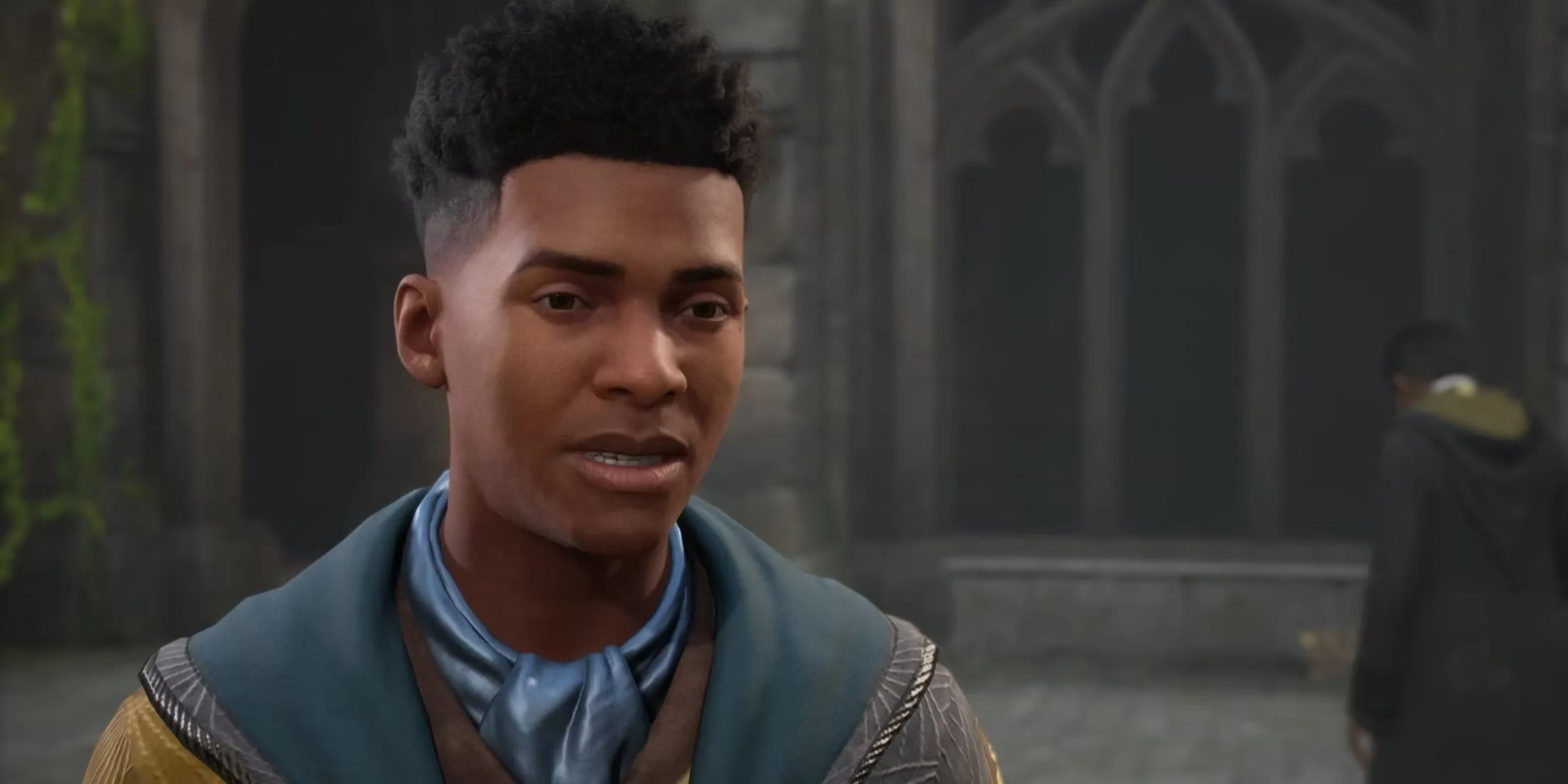
The Protagonist's Predicament: A Legacy of Being Different
Let's talk about us—the player character. Our hero wasn't your typical first-year. We arrived at Hogwarts as a fifth-year, a late-blooming witch or wizard whose powers only awakened around age 15 or 16. This immediately set us apart in a world where most discover their magic at 10 or 11. We were an outsider, stepping into a tight-knit community where our classmates had already spent years building friendships, rivalries, and a whole library of shared memories. Honestly, thinking about it now, the game didn't fully explore the social awkwardness or the sheer academic disadvantage that should have come with that. We were playing catch-up in every sense, which leaves a massive, unanswered question for a sequel: What happens to our education?
-
The Timeline Trouble: Hogwarts is a seven-year program. We showed up for Year 5.
-
The Social Struggle: We missed the foundational bonding years.
-
The Narrative Gap: Our unique "ancient magic" connection was cool, but our personal scholastic journey felt... abbreviated.
Sequel Scenarios: Mass Effect Magic or a Fresh Start?
So, how does Hogwarts Legacy 2 handle this? One compelling idea is to follow the path of legendary series like Mass Effect, letting us import our meticulously customized hero directly into the next adventure. This creates continuity and lets our choices resonate. But it also comes with major storytelling hurdles:
| Pros of a Direct Sequel | Cons of a Direct Sequel |
|---|---|
| 🧙♂️ Player investment carries over | 🔄 Risk of retreading familiar ground (the castle, some characters) |
| ✨ Our unique ancient magic story can deepen | ❓ The first game's plot was fairly self-contained, with few major loose ends |
| 🎭 Our relationships with professors & peers can evolve | 📚 The biggest issue: our character's truncated academic timeline |
The last point is the real incantation in the room. If it's a direct sequel, what year are we in? Do we graduate after just three total years at Hogwarts? That feels rushed and unearned. The more logical, and frankly more interesting, path is that we'd be held back. Not for failing, but because catching up on five years of magical theory, potions, and history of magic in just three is... well, let's be honest, even with a Time-Turner, it's a stretch.
Holding Back to Leap Forward: The Narrative Potential
Imagine this: our hero, now a seasoned sixth or seventh-year in terms of life experience and power, is sitting in classes with students a year or two younger. This creates a fascinating dynamic!
-
A Leadership Role: We could naturally become a mentor or prefect-like figure for the younger students, guiding them through pitfalls we've already navigated.
-
Complex Relationships: How do our original classmates, who've moved on, view us? What's the dynamic with professors like Fig and Weasley, who know our true potential and the burdens we carry?
-
Deeper Storytelling: This "held-back" status isn't about shame; it's a consequence of our unique origin. It allows the sequel to explore themes of belonging, time, and the non-linear path of growth in a way the first game only hinted at. We weren't just a student; we were a relic-keeper and a beast-saver. Now, we could be a leader-in-training.
A Canonical Solution: Borrowing a Page from Hermione's Book
Now, here's a spellbinding alternative straight from Wizarding World canon that could solve everything: time travel. Remember Hermione's Time-Turner in The Prisoner of Azkaban? She used it for extra study hours. What if Hogwarts Legacy 2 introduced a similar, regulated time-manipulation mechanic? This wouldn't be for grand plot adventures initially, but for academic enrichment.
-
Gameplay Integration: Attend two classes scheduled at the same time. Re-do a particularly tricky potion-brewing lesson to perfect it. This mechanic could even tie into mastering our ancient magic, suggesting it has a temporal component.
-
Narrative Justification: The Ministry or the Hogwarts faculty, recognizing our vital role and late start, provides a controlled temporal artifact to ensure we receive a proper, seven-year-equivalent education. It side-steps the age/graduation issue elegantly.
-
High-Stakes Twist: Of course, as any Potter fan knows, tampering with time has consequences. This could evolve from a study aid into a major plot point later in the game, creating risks and moral dilemmas.
Looking to the Future: What's Next for Our Legacy?
As we speculate about 2026, the sequel's setting is just as crucial as its hero. Do we stay at Hogwarts for a "post-graduate" year dealing with a new threat? Do we venture into the wider wizarding world—London's Ministry, Diagon Alley, or other magical schools—for a cooperative project? Our character's unusual maturity and power level could justify moving beyond the castle walls for more adult-oriented adventures, perhaps even as a Junior Auror-in-training. The foundation is incredibly strong. We have a beloved world, a successful formula, and a protagonist whose story is uniquely unfinished. The challenge for Avalanche is to turn our hero's biggest weakness—their delayed entry into the magical world—into the sequel's greatest strength, crafting a narrative that feels like a natural and magical evolution of the journey we started. The portkey to success is already in their hands; they just need to choose the right destination to apparate to next. 🧳✨
Comments