As I, a battle-hardened game critic with a wand-hand that has cast more Stupefy spells than the entire Slytherin common room, gaze upon the still-fresh sales runes of Hogwarts Legacy in this glorious year of 2026, my Spidey-sense tingles with equal parts anticipation and dread. The original game was a phoenix rising from the cynicism of pre-launch skepticism—a confounding spectacle that dared to set its story an entire century before the boy who lived. That temporal distance was its Felix Felicis; it let Avalanche Software craft a narrative as pristine and undisturbed as a frozen Pensieve memory, untouched by the sticky fingerprints of established canon. And now? Whispers from the Ministry of Leaks suggest a sequel is brewing in the cauldron, but I swear on my favorite golden snitch that if this sequel drowns itself in fan-service, I will personally march into Avalanche’s studio and transfigure every whiteboard into a screaming mandrake.
Let me paint you a portrait with words as vivid as a Veela’s charm: the first Hogwarts Legacy felt like being handed a pristine, leather-bound journal of entirely blank parchment. No smudges from Harry’s signature, no Dumbledore’s cryptic half-truths scribbled in the margins. We soared over the Highlands on a broom with the wind screaming past our ears, a freedom so pure it felt like we’d swallowed a cloud and spat it out as our own personal weather system. 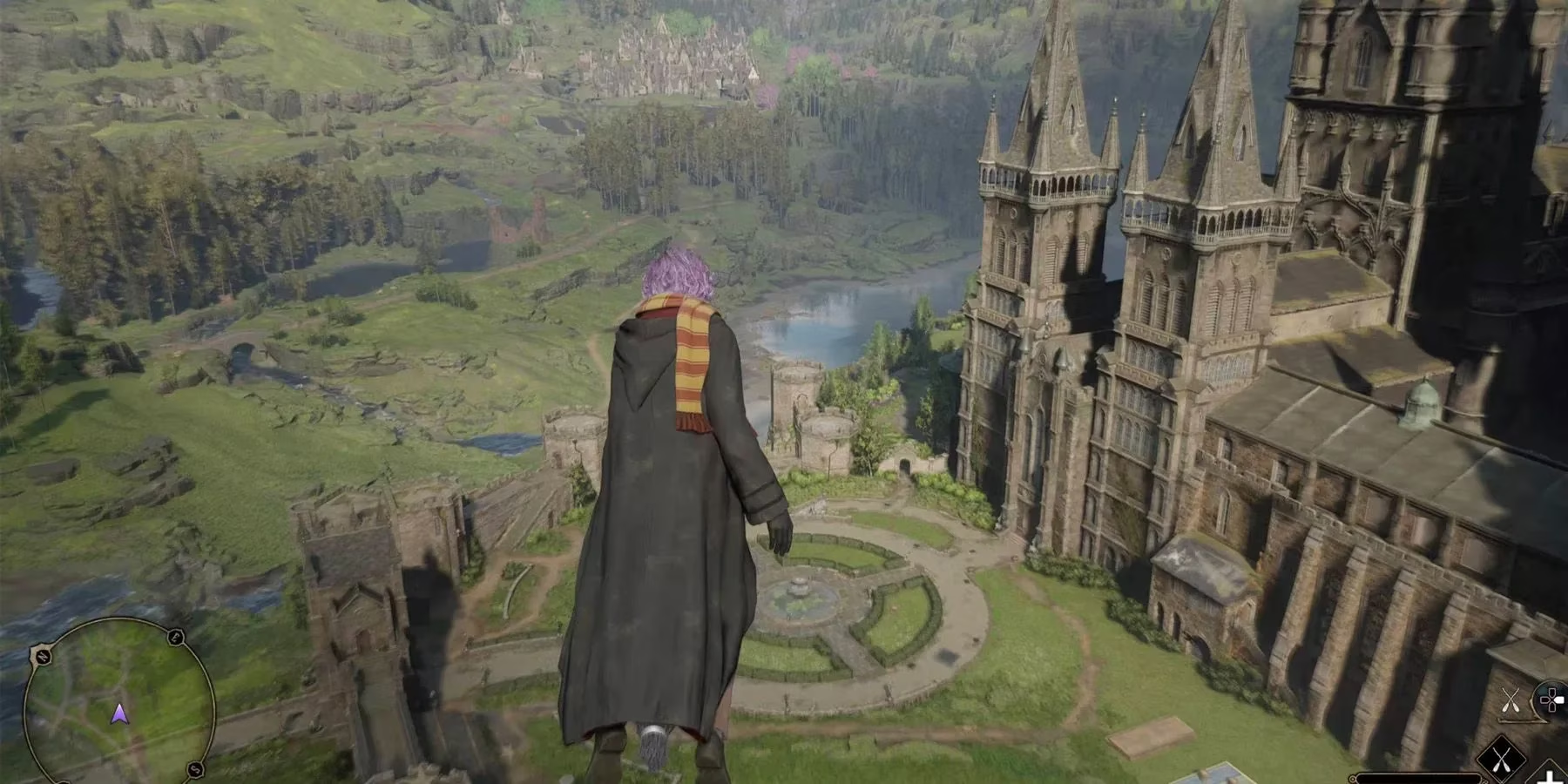 That image isn't just promotional fluff—it's the very soul of what made the game a triumph. We weren’t tourists on a pre-paved path; we were pioneers carving a new story out of the magical wilderness.
Now, the danger is that Warner Bros., high on the galleon-drenched success and still nursing the festering wound left by the Fantastic Beasts franchise’s fizzle-out, will want to stitch the sequel tightly to the familiar quilt of Potter lore. This would be about as tasteful as stapling a neon sign reading “DUMBLEDORE SLEPT HERE” onto the Great Hall’s enchanted ceiling. Godric’s heart, can you imagine it? Our customizable fifth-year, now a sixth-year with the dark shadow of ancient magic still tingling in their veins, suddenly being forced to run an errand for a doddering, pre-legend Albus, who just happens to be a first-year at the exact right moment history demands it? That’s not a plot; that’s a hostage situation where creativity is the victim, and nostalgia is the unhinged captor holding a wand to its throat. The sequel would immediately transmute from a gripping original epic into a checklist of “Before They Were Famous” cameos, each one flattening the world like a steamroller running over a meticulously built sandcastle.
I remember the pre-launch era of 2023 as if it were yesterday. The gaming community’s brows furrowed deeper than the wrinkles on a crumpled piece of parchment. “A Hogwarts without Harry, Ron, and Hermione?” they shrieked, like house-elves who’d been offered clothes. The very concept seemed as appealing as a butterbeer laced with Skele-Gro. Yet, that disconnection—that glorious, golden severance—was precisely the counter-charm that made it all work. The narrative wasn’t forced to twist itself into a pretzel trying to explain why a random student was dealing with a goblin rebellion and a reservoir of painful emotions that physically manifested as dark magic, all while avoiding the timeline-police that are obsessive fans. Avalanche could actually tell a story without J.K. Rowling’s retrospective tweeting (may that controversy forever simmer in a sealed jar) breathing down its neck. The studio gave us Sebastian Sallow’s desperately tragic arc, the morally grey labyrinth of the Dark Arts, and a Hogwarts that felt lived-in rather than museum-ified. Try pulling that off if you have to shoehorn in a scene where we accidentally invent the Marauder’s Map or, Merlin forbid, help a young Hagrid smuggle his first acromantula.
Yet, a dark omen looms on the chronology chart. The game’s 1890s setting is hurtling toward the birthdates of characters we know all too well. The temptation to crack open that chocolate frog card of references will be immense, and it will be the equivalent of opening the Chamber of Secrets inside the Room of Requirement—a cascade of obvious, self-congratulatory callbacks that drown the new story like a tidal wave of treacle. I can see it now: the player character rounding a corner and overhearing a prophecy that spells out “neither can live while the other survives” a century early, and the game treating it as a profound wink. That’s not clever; that’s narrative incest, making the universe feel pathetically small and predetermined. The entire message of Hogwarts Legacy was that our own, unnamed, custom-made protagonist was capable of shaping fate without being a footnote in someone else’s biography.
What the sequel needs is not a restraining charm on ambition, but a banishing charm on excessive reverence for the source material. Avalanche should dig its heels into the untilled soil of its own lore. What happened to the ancient magic repositories? Do the Keepers have more secrets that could shatter our understanding of magic itself? Can we explore a wizard university outside of Hogwarts, breaking the mold entirely, rather than retreading the same moving staircases for a primary-school dramaticum? The sequel must treat the Harry Potter timeline as a poisonous pufferfish: admire its shape and spines from a great distance, but for the love of Merlin’s saggiest left sock, do not bite it. A subtle portrait of a Gaunt here, an ancient wand maker there, these are the delicate spices that can season the stew. But the moment the main quest relies on the player’s shock at recognizing a young Tom Riddle’s grandfather, the dish is ruined.
In 2026, the industry is littered with the corpses of sequels that sold their souls for a fleeting hit of memberberry dopamine. I refuse to witness Hogwarts Legacy’s sequel become one of them. The moment I hear the official reveal event mention “familiar faces” as a core feature, I’ll know we’re headed straight into a dementor’s kiss of creative bankruptcy. My ultimatum is as clear as a freshly polished prophecy orb: let this franchise be the star chart of an undiscovered sky, not a dusty museum tour guide pointing a bony finger at “the exact spot where Voldemort will one day theoretically sneer.” Avalanche proved they are master storytellers; now they need the galleons—and the guts—to tell a new story, not just autograph someone else’s. If they don’t, the franchise will collapse under the weight of its own canon like a Gringotts vault built on a sinkhole of basilisks.
Comments